Sunday, November 29, 2009

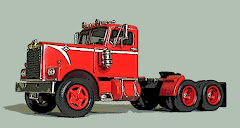
Rare Ford COE Twin Engine


Persistence has paid off in solving the mystic behind this mid 40's FORD COE TWIN ENGINE---

This is perhaps one of the rarest examples of Ford ingenuity in existence today -- for a fact it is the only one. Here is it's story quoted from another web page.


"As the fires of war engulfed much of the globe in the mid-to-late thirties, the free world that still existed turned to the United States for help. American factories began to reap the profits from that foreign war. As the firestorms of war engulfed more and more of the globe, it became evident to many in the U.S. that we must prepare to defend our way of life. The problem was that all of the possible aircraft plants in the U.S. had contracted all of the production that they could possibly handle to the British and others.

It was at this point that the federal government turned to Henry Ford with the question, "Can you build aircraft (bombers) the same way as you have built cars?" Mr. Ford replied, "I suppose, Let’s take a look," At this point Mr. Ford along with a group of company officials went to San Diego, California to look at Consolidated Aircraft’s B-24 Bomber assembly line and designs. From this visit and others the famous Willow Run plant and its production came into being. The main point with which we are concerned is that Lloyd Lawson of the E &L Transport Company was in the group to look into providing transportation of the components which would be produced at Willow Run Ill. The components of the bombers would be shipped to San Diego Ca., Fort Worth, Texas, and Oklahoma City Okla. where plant space was available.

Lloyd Lawson returned to E&L Transport Company in Dearborn, Michigan. The company designed the twin engine Ford truck tractors, using 2-100 horse powered Ford truck engines driving 4-speed Warner transmissions and Timken differentials. Each engine had it's own, ignition switch, gauges, radiator, Transmission drive shaft and rear end. This was basically tow-one and a half ton trucks in one chassis using standard off-the-shelf cabover engine Ford truck parts. Some parts were modified, but all were Ford. The drawing board and blue prints consisted of the plans being drawn on the concrete floor with soap stone. The engineers consisted of the men working in the shop. The total production number of these vehicles was 96 to 98. About one half of these vehicles had the rounded cab as does #50. The other trucks were designed with the more square cab."


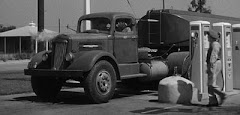
According to the caption for this June 17, 1942, photo, this is simply a “Ford truck to haul bomber parts,” but our friend Fred Crismon, author of “U.S. Military Wheeled Vehicles,” has more:

Early in 1943 [which clashes with the date of the above photo -ed.] this highly specialized vehicle was shown to the public, identified as a tractor designed to pull a 60-foot-long “supertrailer” in which 34 complete tail cone assemblies could be carried. The tail cones were for the B-24 bomber of which Ford was one of several builders. The assemblies were carried between several manufacturing plants according to contemporary sources, invluding runs between California and Texas, Willow Run, Michigan, and Tulsa, Oklahoma, and Fort Worth, Texas, and between Loudonville, Ohio, and Buffalo, New York. Two Mercury V-8s were used, driving into synchronized transmissions.

Crismon also noted that the tractor was rated at 10 tons and that the trailer was loaded from the top by overhead cranes. About 70 of the trucks were built, and the twin engines were accessed by pulling them as a unit out the front of the tractor. Crismon provides evidence that, although Ford was often mentioned as the builder of the trucks, a company named Thorco Dual Motors built them – Thorco being a trademark for the Thornton Acle Company. However, James Wagner, the author of “Ford Trucks Since 1905,” wrote that about 100 tractors were built by E and L Transport of Dearborn, and the corresponding trailers were built by Mechanical Handling Systems.


Saturday, November 28, 2009

A Rare and Unusual FORD COE


My good friend JERRY over at HANK'S TRUCK FORUM has come up with another stumper. It is this FORD TWIN ENGINE COE.

If you look closely at the grill, you will notice two radiators. Why? This truck had two engines, that's why. Apparently FORD built this truck for military use. It had a 70 foot trailer used for hauling aircraft parts.

What is not known are the specifications, how many were built, what engines were used, what year was this manufactured in? As far as I can find, this picture found by Jerry is the only one on the net. It might have been taken at an ATHS show.

Any further info about this truck would be appreciated -- it certainly deserves more recognition!!


Thursday, November 26, 2009

Beverage Trucks -- 1920 -1960


While on a recent trip to Buffalo to visit our son, I happened into a flea market and came across this FORD COE beverage truck. When I purchased it for $15 dollars to add to my collection of models and die cast trucks, it did not have the A&W logos -- those are my doing.

Those of you that look at this thread from now and then know that I have been "absent" at periods -- this due to the time I spend on HANK'S TRUCK FORUM. This has NOT been time wasted though, as I have started a thread devoted to the obscure BEVERAGE TRUCK.

This thread contains lots of cool pictures of all kinds of "beverage trucks" and some forgotten brands of soda, beer, and dairy products.

Come take a look ----- The Beverage Truck -- 1920 -1960 -- Hey, you might even want to post a few pictures of your own, comments welcome too.

Thursday, November 19, 2009

Round 2 LLC Release of AMT WHITE FREIGHTLINER DUAL DRIVE TRACTOR


I was pleased when it arrived five days latter. Round 2 was true to the memory of that old AMT kit. The instructions were just like the ones from the old kit. The parts were clean and the chrome did shine. My only complaint was the decals were too thick -- even decal solvent didn't help. The build up was exactly how I remembered the original.

Here are some pictures of "SPIKE"


Tuesday, September 15, 2009

A Case of the WILLY'S


This past summer brought about a pleasant surprise, a vehicle I hadn't seen in a long time and the chance to actually get in one for the first time since the early 60's.

Just up the road from where I live I spotted a Willy's Jeep FC-170. This was a former fire vehicle belonging to the small village of Millport, and it was being sold. Despite the fact that it hadn't run in four years and the brakes were not working it was in very decent shape otherwise. I have always wanted one of these as my dad had one back in the late 50's. It was my favorite of all the trucks my dad had. I should have jumped when I had the chance -- final sale price -- $5900.


Sunday, August 30, 2009

Alens REO

I recently received the following e-mail along with some GREAT pics of a REO belonging to ALLEN VERMAN ----


hi there
ran across your site with the pic. of the old REO truck and thought that since you like old trucks so much i'd send a couple pictures of my '34.
i have had virtually no luck finding pictures of a truck like mine anywhere, it's a model 1B, without a bed at the moment untill i find a suitable style to use as a model.
we are wondering what this truck did for a living, the thing has lots of miles, but the secondary springs are not worn, other drive train parts show quite a bit of wear.
another truck nut
allen verman
cuba, ohio


Thanks Allen for the e-mail and the great pics --- NICE TRUCK YOU LUCKY MAN!!!

In search of WALTER


No, not the Jeff Dunham character, but great trucks known as WALTERS. My quest was to view and photograph the WALTER SNOW PLOW collection of Gerald Johnson in Lapeer, NY, just west of Marathon.

First, a little history about the WALTER

------------------------------------------------------------------------------------

William Walter was a Swiss immigrant, and came to the U.S.A. in 1883 and established himself as a manufacturer of candy and confectionery machinery. He built himself a passenger car in 1898 and from 1904 to 1909 made high­ quality cars, at first in New York City and later at Trenton, N.J. Truck production began in 1909 a t the New York factory on West 66th Street, and in 1911 the first 4-wheel­ drive trucks appeared, which were to become the staple product of the company. Based on the French Latil and of similar appearance with radiator behind engine, they were made in sizes from 1 ½ to 7 tons. Conventional rear wheel drive and also front wheel drive trucks were also made, all with internal gear drive to the wheels. Engines were Walter's own make up to 1920, then mainly Waukesha during the 1920s. Gradually the rear-wheel-drive models were phased out, although a 15/25-ton rwd tractor with 5­speed gearbox was made as late as 1924. By the mid-1920s Walters had assumed their characteristic appearance with engine projecting ahead of the front axle; in 1929 the first Walter Snow Fighter appeared, and this was a field in which the company later became well-known, as well as for highway maintenance work and carrying cement mixers. During the 1930's Walter supplied a number of fire engines to New York City. Articulated dump trucks were used in open-cast coal mining, and Walters were also seen in the logging industry. By 1940 there were six models, all with 4-wheel-drive, of 3 to 12 tons capacity. Engines were 6-cylinder units by Waukesha, Hercules and Cummins, the latter a diesel.

During World War II Walter supplied 4 X 4 artillery tractors with 672ci 6-cylinder Hercules engines to the U.S. Army, and also snow removal trucks with Waukesha engines to both U.S. and Canadian forces. After the war the 4-wheel-drive trucks were continued, and Walter entered a new field with the building of airfield crash tend­ers. These were developed in conjunction with the Federal Government, the Port of New York Authority and the National Fire Protection Association. Current production includes crash tenders with single and twin engines, refuse collection trucks and the familiar 4-wheel-drive trucks and snowplows.

-------------------------------------------------------------------------------------

Our drive from Horseheads took about 1 1/2 hours, and I am sorry to say that upon our arrival Gearald was not present, the house across the road completely empty.
I had found out about this collection through my friends over at HANK'S where we have been discussing these brutes in a forum. Here is a taste of what I found --


This is just a small sampling of what I found. If you want to see more pictures, and read some more stuff about the WALTER, check out the post's on HANKS TRUCK PICTURE FORUM, the
WALTER THREAD --- remember to check out the previous five pages!!!

Sunday, August 09, 2009

2009, 10th Annual National Brockway Truck Show

WOW, even that does not describe my day with over 120 beautiful BROCKWAY trucks. No, you can not have TOO MUCH of a good thing!! I arrived in Cortland via route 13 at 7:30 AM to find this beauty parked along the road ---


I then found a spot to park, no problem. Then it was on to the parade route. The parade started on time and you could hear the trucks before you saw them, blowing those air horns, and jaking their trucks --- I wish I could have captured that in my pictures.

At any rate, you can enjoy my day here in VIRTUALITY by way of YOU-TUBE ---


Friday, July 24, 2009

Mystery of the "IRONSIDE" Paddy Wagon

The popular TV series "IRONSIDE" was produced by Universal Studios and ran from it's premier in 1967 until 1975. The first thirteen pictures in this video show the Paddy Wagon that was used to carry Robert Ironside (played by Raymond Burr) from place to place during the first three seasons. It should be noted that while modifications were made to that vehicle, the overall body remained unchanged -- I like to think of this vehicle as "THE IRONSIDE PADDY WAGON"

The last three pictures show what I call the "Demise Vehicle". This similar looking truck was used early in the third season when the "PADDY WAGON" met its' death.

Note very carefully that this is NOT the original vehicle. The rear fenders are different. The windshield is rounded, the door windows are different, and the box extends to hide the chassis behind the running board. Also, I do not believe that "THE IRONSIDE PADDY WAGON" had an air scoop vent just in front of the windshield.

It is my unproven contention that the vehicle used in the demise was a "parts" vehicle.

If that is the case, what happened to the "REAL THING"?


Give me your thoughts ----


Friday, July 10, 2009

That Old Sleeper Cab

I have always been fasinated by those great old trucks with integrated or integral "Sleeper Cabs".
That is not to say that I don't like trucks that have a separate sleeper unit, like my 69 Pete 359 model.

This is a little video I threw together that covers in a round about way the development and evolution of the "Sleeper".


Hope you enjoy!!!